SEO agency or freelancer for a trade business? The choice is not size, it is which jobs need a rota
In a sweep of 233 UK trade businesses across three market towns in Shropshire, 179 showed a star rating on Google. Of those, 162 sat at 4.5 or above and 96 were on a flat 5.0.
Then the second number, which is the one worth carrying into a meeting with a supplier. The businesses rated a perfect 5.0 had a median of four reviews. Everybody rated below 5.0 had a median of twenty-nine. A perfect score is usually a thin score, and nobody is sitting at the top of a local pack because of the number of stars next to their name. They are there because of volume, recency and a profile somebody keeps current.
That decides more about who you should hire than the size of their office does. The star rating is the one thing no supplier can touch, the review count is the one thing they cannot produce without you, and almost everything else that moves a UK trade business on Google is a small job repeated every few weeks. Hold that in mind and the agency question stops being about headcount.
Choose on accountability and on the shape of the work, not on size. An agency buys you breadth, cover when somebody leaves and specialists for short technical jobs. One person buys you somebody who knows which of your jobs finished last Friday. For most UK trades the deciding question is which jobs the four-week cycle actually contains.
The star rating is not what you are paying anybody to move
Ratings barely separate anybody. In 179 rated trade listings across Ludlow, Craven Arms and Church Stretton, nine in ten sat at 4.5 stars or better and only seven were below 4.0.
I keep cold-call lead sheets of UK trade businesses, and in September 2026 I swept eighteen trade searches across those three Shropshire towns and deduplicated the results by business name and phone number down to 233 distinct businesses. One listing is excluded from everything below: the landscaper search returned Shropshire Hills National Landscape, which is a protected-landscape body rather than a contractor, and its 5,345 reviews would have accounted for three fifths of every review in the set on their own.
Fifty-six of the ninety-six perfect scores rest on five reviews or fewer. The median across every rated business is ten, and only thirty-seven of the 179 have reached fifty. So the star figure tells a customer almost nothing, because everybody has a good one, and it tells you nothing about your supplier either, because no amount of money buys it. What is left to work on is the slow half: more reviews, more recent, on a profile that is filled in and a website the profile can send people to.
That is the real brief you are handing somebody. It is not a campaign with a start and an end. It is a cycle, and what a cheap SEO package quietly leaves out of that cycle is the same list whether the supplier is a firm of thirty or a man with a laptop.
Capacity work and continuity work
Sort the four-week cycle into jobs that need more hands and jobs that need the same hands, and the agency question answers itself per row rather than overall.
Capacity work is wide: a technical fix across two hundred pages, a batch of service pages, a site migration. More people genuinely make it faster and better. Continuity work is narrow and endless: asking the customer who signed off on Friday for a review, replying to the one that came in rude, noticing that you have started doing air source heat pumps and the profile still says boilers. More people make that worse, because the knowledge lives in whoever did it last time.
| The job, every four weeks | What it actually needs | Shape it suits |
|---|---|---|
| Reviews asked for after finished jobs | Knowing which jobs finished, and asking the same way every week | One person, close to your diary |
| Business Profile upkeep: services, photos, posts, replies | Your words and your photographs, in small amounts, often | One person |
| Town and service pages written properly | Hours, and somebody who can write about your trade without padding | Either, if the writing is really done by a person |
| Technical work: speed, indexing, schema, redirects | Specialist hours in bursts, then nothing for months | A team, or a specialist hired once |
| Measurement: grid scans, Search Console, call tracking | One fixed method, repeated identically, by somebody who remembers last time | Either, if the method is written down |
The left column is the cycle I run for clients and the middle column is what each job needs from the business. The right column is a judgement, not a rule: a disciplined agency with a named account manager does the top two rows perfectly well, and a sole supplier who has gone quiet does none of them.
Where the split actually bites
Three of those five rows need something only your business holds. That is why the agency pitch tends to lead with the two rows it can own outright, the pages and the technical work, and why the first thing to go missing six months in is the review asking. Nobody decides to stop. It just belongs to whoever is on the account this quarter.
Google has built a separate account type for agencies
Google treats a third party managing your listing as a different kind of thing from a person helping you, and the documentation is worth reading before you hand over access.
An organisation account is a type of Business Profile built for third parties responsible for managing locations on behalf of the business owner. It can only manage a listing once the listing has granted it permission, and agencies are told to run all of their client profile groups through a single organisation account. On top of that sit user groups, which exist so a team of people can be given the same level of access to the same set of locations.
Read that back as a buyer and it is a fair description of the trade-off. The team structure is real, it is supported, and it means the work survives somebody leaving. It also means the person who writes your review replies next spring may be nobody you have met. A sole supplier has no use for any of that machinery: they are added to your profile as a manager, the same as your office manager would be.
Either way, the rule is the same. Keep ownership and grant management. Google's help pages are clear that only owners can remove other owners and managers, so an owner you have fallen out with is an owner you cannot remove, and a newly added owner or manager has to wait seven days before they can use every feature. Grant the lower level and the worst case is an afternoon of awkwardness rather than a recovery process.
What a one-person supplier looks like, including the part that is a risk
I am the one-person option, so the honest version is the useful one: the ceiling is real, the holiday is real, and the thing you get in exchange is that nothing is ever handed over.
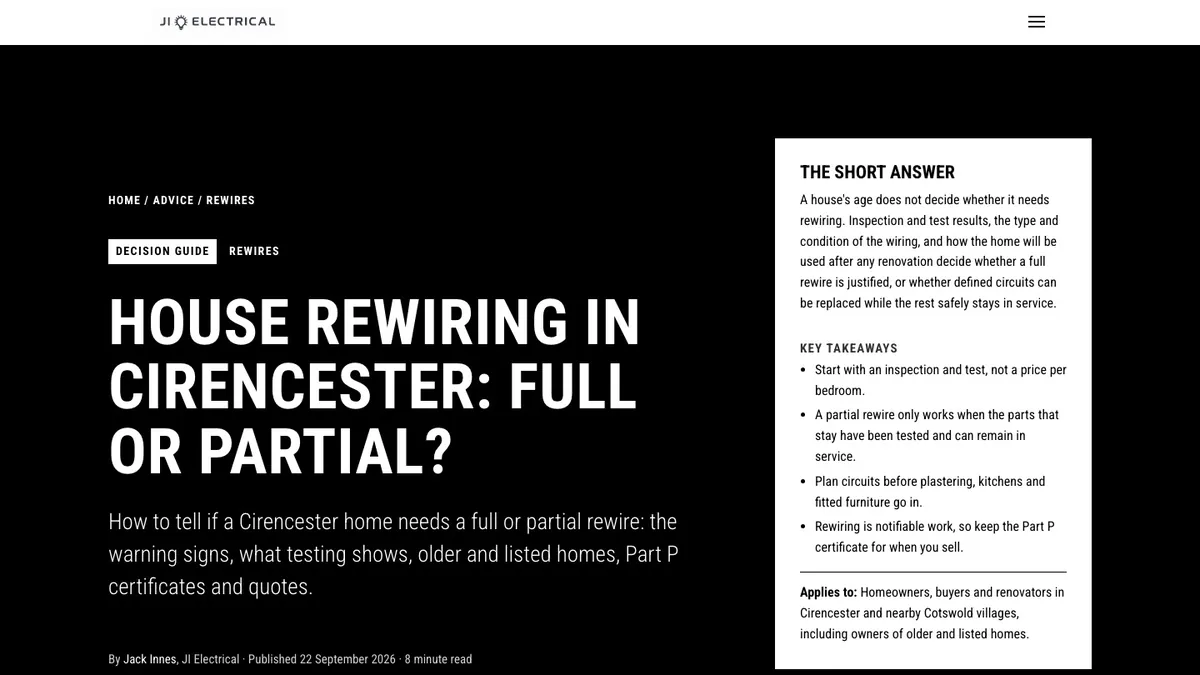
Sitework runs ongoing SEO for six client businesses alongside two of its own. One of them is JI Electrical in Cirencester, and it is a useful example because it is deliberately narrow. The website was built by somebody else before I started and has not been redesigned. The work underneath it is the search work: titles, descriptions, headings and schema that name the town, a move to faster hosting with redirects so nothing indexed breaks, local articles written around what homeowners and landlords in the Cotswolds actually ask, and Business Profile details brought into line with the site. Map positions were recorded at the start and are re-checked the same way at fixed points, so any movement is measured rather than claimed.
That is the shape a single supplier is good at. It is also the shape where the risks are obvious. One person has a hard ceiling on how many clients can be served properly, takes holidays, and is a single point of failure on a bad week. The question to ask is not whether that risk exists, because it plainly does. It is what happens to the cycle during a fortnight away, who holds the access, and whether anything in the month is genuinely time-critical. Most local search work is not. Hosting is the exception, which is why knowing who you ring when the site goes down is a separate conversation from the SEO one, and worth having before you need it.
So which do you call?
Three situations cover almost every UK trade business, and only one of them points at an agency.

Three checks that work on either of them
Run the same three checks on an agency and on a freelancer. All three are free, none takes more than a few minutes, and the answers are not marketing.
Check the ICO register
Whoever you hire will be handling enquiries from your customers, which is personal data, and in Britain most organisations processing it owe the annual data protection fee. The ICO publishes a searchable register of fee payers with more than a million entries on it, showing the organisation's name and address, its registration reference, the fee tier it pays and the dates it registered and expires. It takes under a minute. The registration date is also a quiet age check on a supplier who describes themselves as established.
Ask for the access level in writing
Manager on the Business Profile, user on Search Console and Analytics, nothing on the domain registrar. If the answer is that they need ownership to work efficiently, that is a preference rather than a requirement, and it is the one preference that is expensive to undo later.
Ask what they will not be doing
The most useful sentence in any of these meetings is the list of jobs that are outside the fee. Both shapes of supplier have one. An agency's tends to be the slow relationship work; a sole supplier's tends to be anything that needs a fortnight of specialist time. Knowing which half is missing tells you what you are picking up yourself, and that is the real price.
Stop comparing an agency to a freelancer and compare two task lists. Write down what has to happen every four weeks for your business, in your towns, on your trade. Hand the same list to both and ask which rows they are doing, who by name, and how the result is measured. On most single-trade, single-patch UK businesses the list is mostly continuity work and the named person wins. Where there are branches, ad spend or a genuine technical backlog, the breadth is worth the overhead. Size is the last thing to weigh, not the first.