I opened the homepages of the five roofers who held the top organic spots on Google Maps for "roofer worthing" on 2 October 2026, and not one of them names TrustMark, the National Federation of Roofing Contractors or a roofing competent person scheme.
Two of the five mention Checkatrade. Three use the word guarantee and two say "insured", but none gives a length, an insurer or a document behind it, and one of the five uses none of those words. Yet roofing is the job where a homeowner is most likely to ask what happens if it leaks in year three, and every one of these firms sat on the first screen of Google Maps. That is the gap a roofer should be asking an SEO company about, and it is not the gap most roofing SEO pages talk about.
So this is a buying guide, not a how-to. If you are a roofer in the UK weighing up whether to pay someone for SEO, here is what the Worthing pack shows, what a homeowner can actually check, what Google says it ranks on and the sum on the fee.
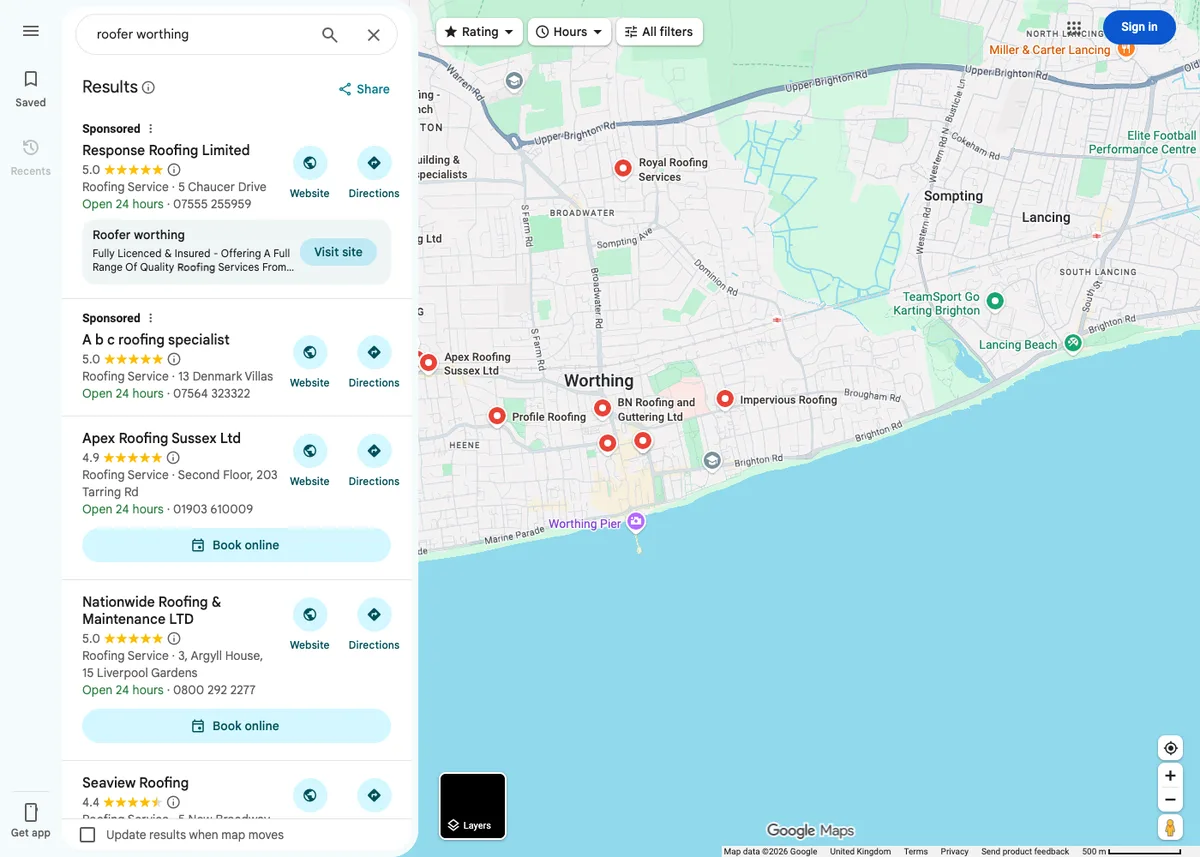
What the Worthing roofing pack shows, and what it cannot
On 2 October 2026 the Google Maps pack for "roofer worthing" showed two paid listings, then Apex Roofing Sussex at 4.9, Nationwide Roofing & Maintenance at 5.0 and Seaview Roofing at 4.4, and nothing in it says whether any of them is registered with anything.
That is the capture above: a signed-out Google Maps search centred on Worthing, run on a weekday afternoon. Each listing gives a star rating, a category, an address, a phone number and opening hours. A homeowner choosing between them has a rating and a postcode. Whether the firm sits on a register, who insures the guarantee and how long it lasts all live somewhere else, which means the website.
I then read the homepage source of the five organic firms. Searching each for "TrustMark", "NFRC", "CompetentRoofer", "guarantee" and "insured" turned up Checkatrade on two, the word guarantee on three, "insured" on two and no scheme names whatsoever. One of the five carried none of the five words. This is five firms in one UK town on one day, not a survey of the roofing trade, and a site may show a logo as an image I cannot read from the page text. What it does show is how little proof a firm needs to be on the first screen of Maps in Worthing, and how much room that leaves.
The proof ladder: what a homeowner can check about a roofer
The things a homeowner can verify without ringing you are the things your website should carry, because each one answers a doubt before the phone call and a roofing SEO fee is worth more when it is spent on those pages.
| What they can check | Where they check it | Shown in the Maps pack? | What your site needs |
|---|---|---|---|
| TrustMark registration | TrustMark find a tradesperson search by trade and postcode | No | Your registration, linked to your listing |
| NFRC membership | NFRC trade member directory | No | Membership stated, with how to check it |
| A competent person scheme | gov.uk list of authorised schemes, which names CompetentRoofer and NAPIT for replacement roof coverings | No | Which scheme, if any, and what it lets you certify |
| A written guarantee | The document itself: who issues it, how long, what it covers | No | A sample guarantee, with the length and the insurer |
| Insurance | The certificate, asked for before work starts | No | The cover stated and a way to request the certificate |
| A real address and area | The listing and the website, which should match | Address, yes | The same address and the towns you cover, in plain sentences |
| Reviews from real jobs | Google reviews | Rating, yes | A few reviews quoted next to the job they describe |
Read down the third column. Five of the seven are invisible in the pack, so Maps can get you the click but not the trust, and a page that finishes the argument is the only place that can. The table also keeps you honest: if you are not on a register, do not imply you are, and where a guarantee is not insurance-backed, say what it is. I cover how to show a registration properly in showing Gas Safe, NICEIC and TrustMark on your website, and the same rules of genuine logos and register numbers apply to roofing schemes.
What SEO can and cannot do for a roofer
Google ranks local results on relevance, distance and prominence, and its own help page says there is no way to request or pay for a better local ranking.
Anyone who promises a roofer a position for money is selling something Google says is not for sale. What a fee can legitimately pay for is the work that moves those three factors. Relevance is a Business Profile that names your categories and services accurately and a website with a page for each job you want, such as a re-roof, a flat roof or a chimney repair, in the towns you cover. Distance you cannot change from an office chair, which is why a roofer based in Worthing should not expect to win Brighton. Prominence comes from reviews and links, and Google ties it to how many websites link to you and how many reviews you hold, in its local ranking guidance.
None of that is a secret technique, which is why the pack in a town like Worthing can be won by doing the basics steadily. If you want to see how big the gap above you really is before paying anyone, why a competitor is above you on Google Maps shows the five causes in the order Google responds to them.
What a month of roofer SEO should and should not include
A month of roofer SEO should produce things you can open and count: profile changes, pages, reviews and a position on named searches. A month of "activity" with none of those is not worth paying for.
Here is what a four-week cycle should contain for a roofer, whoever does it. The Business Profile gets worked on: services and categories checked against how you actually describe the job, fresh photos from finished roofs with the town in the caption, and a post. A review request goes out after every completed job, because prominence leans on how many reviews you hold. The website gains pages that match what homeowners search, such as a re-roof, a flat roof or a chimney repair in a named town, each one carrying the proof from the ladder above. And at the end you are sent the numbers: calls, direction requests and where you sit on the named searches.
For comparison, my own four weeks is twelve search-led pages plus the Maps work, with the position measured on a map grid. Whatever the supplier, the same four items should be on the report.
What should not be in the month is as important. No promise of a position, because Google sets that and says it is not for sale. No bulk directory submissions or bought links, which add risk and little else. No articles that name no town and no job, which could be about any trade in any county. No swapped phone number for call tracking on your listing, because the number on Google, the website and every directory should match. And no reviews you did not earn from real customers.
What the fee is, and the sum
At £300 every four weeks, a year of SEO and Google Maps work is £3,900, so the decision is whether it wins you a job or two worth more than that.
My own price is £300 every four weeks on a website you already have, or £350 every four weeks with a website I build and host. A £150 deposit comes off the first payment and there is no setup fee. It runs twelve weeks minimum, then rolling. What it buys is on the SEO and Map Pack page, including the part most fees do not carry: a 7 by 7 grid scan on up to three agreed searches, with billing paused if the average position is not in the top three by day 90.
What a year of it comes to
| SEO and Map Pack, £300 every four weeks | £3,900 |
| With a website built and hosted, £350 every four weeks | £4,550 |
| Deposit, taken off the first payment | £150 |
Thirteen payments a year rather than twelve. This is arithmetic on my own published prices, not a market survey. What one roof is worth to you is your figure, and it is the one that settles the decision.
For a firm whose average job is a few hundred pounds, a monthly fee at this level is hard to recover. For a roofer whose re-roofs run to thousands, one extra job a year covers it. What you should not pay for is vague activity. Ask the supplier what they will measure and how they will report it, before you sign anything.
Three questions to ask an agency before you sign
Three questions separate a supplier who will work for a roofer from one who will bill a roofer: what exactly is measured, whose name everything is in, and what is promised in writing if it does not move.
- Which named searches, in which towns, and how will you measure them? "Roofer" alone is not a target. "Roofer worthing" is. Ask for a map grid scan across your patch rather than one screenshot, because a single search from one spot flatters or punishes you at random.
- Whose name are the Business Profile, the domain and the website in? They should be in yours. If a supplier holds them, you cannot take the work with you, and a profile that needs verifying may need a video filmed at your own premises, which nobody can do for you from an office.
- What do I get in writing if the named searches have not moved by a date we agree? Ask for months you can count and a remedy, not a promise about position.
Those three are the short version of the longer list in what to ask an SEO company before you sign.
Bottom line: for a roofer in a UK town where the pack is held by firms with a rating but no visible proof, the fee is worth paying if it also pays for the proof. If it only buys keywords and posts, keep the money and spend an evening claiming your TrustMark and NFRC pages first.