Why is my competitor above me on Google Maps? Five causes, in the order to check them

You are sat in the van on somebody's drive, you type your trade and your town into your phone, and three businesses sit in the box with the map. You are fourth.

The one on top has eleven reviews to your forty and a website that has not been touched since 2019, which is the detail that keeps people awake. Here is the first thing worth knowing: that search is also the least reliable one you will ever run, because you ran it from the one postcode where your own pin sits closest to the phone. Distance is one of the three things Google says decides a local result, so your own drive flatters you, every time. Before you change a single setting, you need to know whether you are genuinely fourth across your patch or fourth in one spot, because across the UK those are two different problems with two different fixes, and picking the wrong one costs you a season.

Quick answer

A rival outranks you on Google Maps for one of five reasons: they are nearer the searcher, their profile categories match the search better, they have more recent reviews, their website agrees with their listing, or their listing breaks Google's naming rules. Google names relevance, distance and prominence as the three factors. Check distance first: most UK trades diagnose Maps from their own drive.

Start by checking it from somewhere other than your own yard

Google says local results are ranked mainly on relevance, distance and prominence, so the Maps position you see standing in your own yard is the best one you will ever have, not the one your customers see.

This is the cheapest mistake to fix and almost everybody makes it. Distance means how far each business is from the person searching, and Google works from whatever it knows about where they are. Your phone, parked at your own address, is the most favourable point on the map for your own listing. Move two miles and the order changes. Move five and you can vanish from the three while still sitting first at home, which is why a tradesman can genuinely believe he ranks and never get called from the next town.

The way to settle it is to check a spread of points rather than one. A grid scan does exactly that: 49 points in a 7 by 7 pattern across an agreed radius around your base, each asking Google where you appear for the same search. What comes back is a picture rather than a number, and it tells you the one thing a single search cannot: whether your patch is shrinking or your profile is simply weaker than the firm above you. Do it before you change anything, because it is also your before picture. If you cannot find yourself anywhere on the grid, that is a different fault with a different cause, and I have set it out separately in why your Google Business Profile is not showing up.
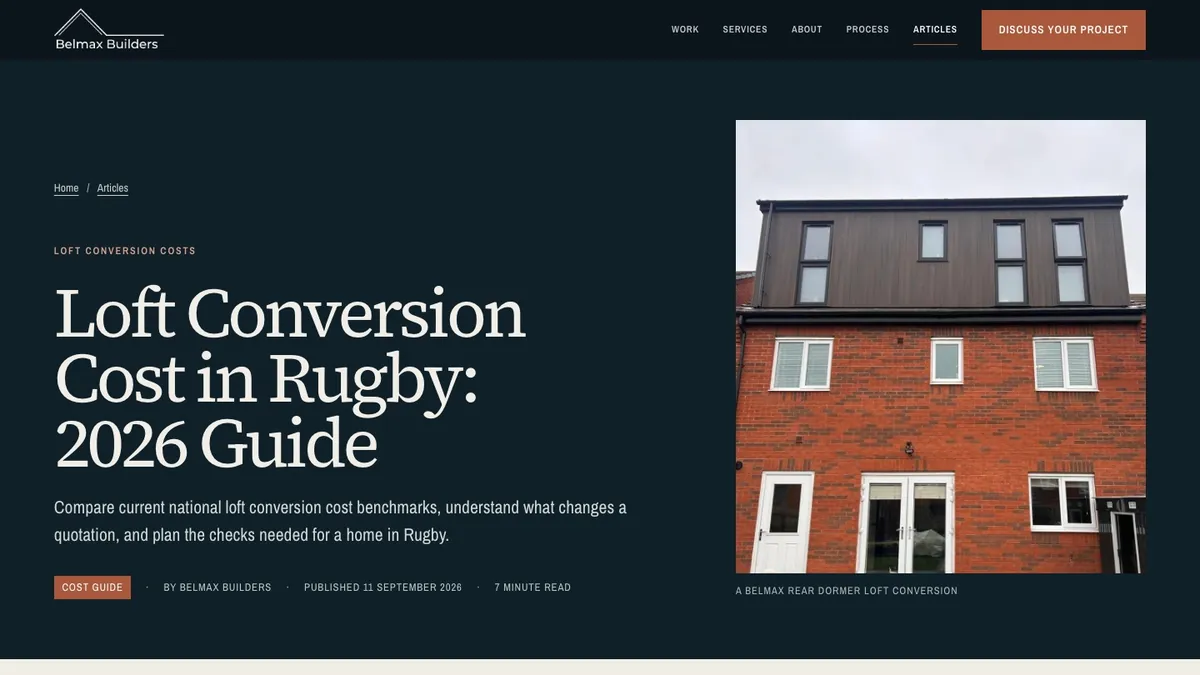
Belmax Builders article Loft Conversion Cost in Rugby: 2026 Guide, next to a photo of a finished rear dormer loft conversion on a brick house.
A Belmax Builders cost guide from the SEO work Sitework does for them. The town is in the title and the photo is one of their own jobs.

Five reasons a rival sits above you, in the order to check them

Work the five causes in the order Google actually responds to them: distance, then categories, then reviews, then whether your website and your listing agree, then a rule-breaking listing. The first two can move a position inside a fortnight. The last one takes weeks and may never land.

The order matters more than the list. Almost everyone starts at reviews, because reviews are the visible thing, and reviews are the slowest of the five. Two minutes on each tells you which one you have.

Check firstTheir pin is simply closer to where people searchThe test: search the same term from three places you actually work, a few miles apart, with your own location off. First at home and gone by the third is your answer. Geography has no fix. Narrow the search to the area you can win, and put a real page on your site for each area you cover instead of one line listing forty towns.
Check secondTheir primary category matches the search and yours does notThe test: open your profile, read your primary category out loud, then read the search. "Electrician" and "Electrical installation service" do not match the same searches. This is the fastest lever on the list, it is free, and it takes a minute. Set the primary category to the job you want to be called for, then add the secondary ones and the services underneath.
Check thirdTheir reviews are fresher, not more numerousThe test: sort their reviews by newest and look at the dates, then look at yours. Forty with the last one in 2023 reads differently to eleven with three from this month. Google says count and score feed into local ranking and publishes no recency weighting, so treat freshness as practitioner judgement, not a rule. The work is the same either way: ask after every job, reply to all of them.
Check fourthTheir website and their listing say the same thing, yours do notThe test: open your listing and your website side by side. Same name, same phone number, same address or service area, same trade words, and the towns named somewhere a search engine reads. A listing claiming bathroom fitting in Horsham pointing at a site that says "quality workmanship, all areas covered" gives Google nothing to confirm. This one usually needs a page built, not a setting changed.
Last, and reportableTheir listing breaks Google's own rulesThe test: read their business name. A trade plus a town plus a promise, rather than a name anybody paints on a van, is in breach of Google's guidelines. So is a virtual office address, a duplicate profile at the same address, or a category unrelated to the work. This is the only cause where the fix is somebody else's listing coming down, and every removal frees one of the three spots.

Relevance is the box most trades have never opened

Your primary category is the single biggest relevance lever on a Google Business Profile, it is free to change, and it takes about a minute.

Relevance is how well a profile matches what somebody typed, and Google's own guidance on local ranking is blunt about improving it: give complete and detailed business information. In practice that is four fields, and most profiles I look at have one of them filled in properly. The primary category, which decides most of it. The secondary categories, for the searches around the edges. The services, typed out by name. And the service area, which should be where you will actually drive, not an optimistic radius.

Categories first, then services, then the area

The commonest fault is a category chosen at sign-up years ago and never revisited, usually something broad like "Contractor". If you fit kitchens, your primary category should say so, and "Kitchen remodeller" and "Kitchen furniture shop" are different bets on different searches. Pick the one that matches the job you want the phone to ring about. Then add every service you sell as its own entry, because the services list is what Google matches against the long, specific searches that convert.

Your website has to agree with your listing

Google checks the profile against the website, so a site that never names a town or a trade leaves the profile arguing on its own. This is not a small problem in British trades. When I audited 100 real UK trade websites by hand off my own cold-call lists, 58 named no town and no service anywhere a search engine would read. An Instagram page cannot close that gap either, because there is nothing on it for Google to match, which is the split I set out in do flooring fitters need a website or just Instagram. The fix is unglamorous: a page per service, a page per area you genuinely work, the same phone number as the listing, and the trade written in words.
The honest limit on all of this. Relevance and prominence you can work on. Distance you cannot. If your rival is in the town centre and you are on a lane four miles out, no amount of profile work wins you a search made in the square. What changes is how far your own zone of the grid reaches, and whether you own the searches made where your customers live.
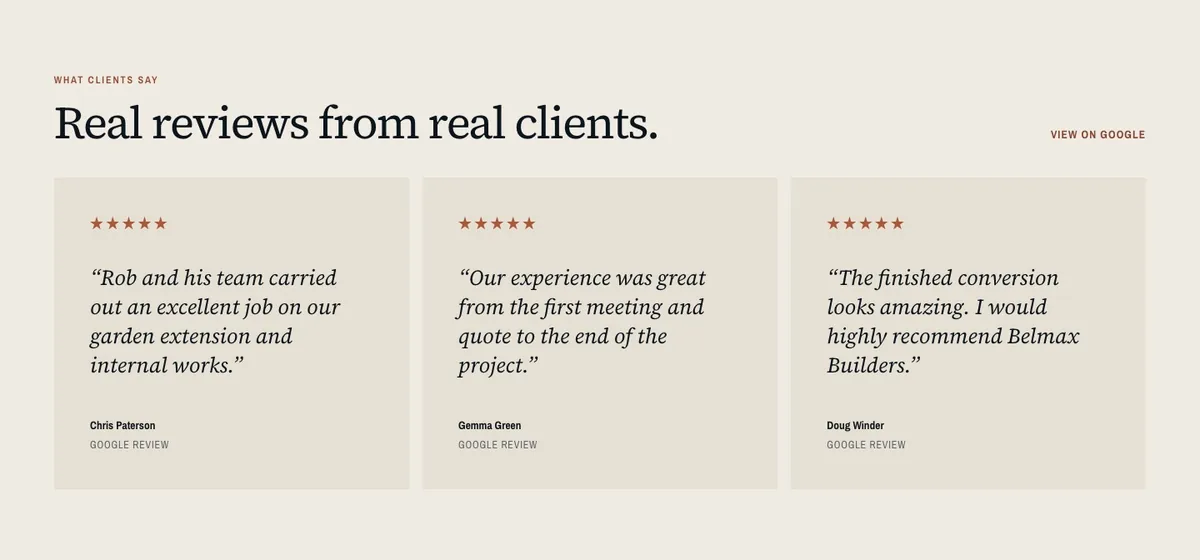
Three five-star Google reviews on the Belmax Builders website under the heading Real reviews from real clients, with a View on Google link.
Belmax Builders' own Google reviews, shown on their website with a link back to Google so a visitor can check they are real.

Prominence is reviews, and a steady flow beats an old total

Google says review count and review score feed into local search ranking, so a rival with eleven reviews and a fresh one most months is building a signal you can start building this week, whatever your total says.

Prominence is how well known a business is, and Google builds it from what it can see: reviews, links, mentions, the rest of the web. Reviews are the part you influence directly, and the trade habit of asking in a burst when things go quiet is the worst possible pattern. A review link on the invoice and a QR code in the van makes it happen by itself after every job. Reply to all of them, including the three-star one: the reply is read more often than the review.

If you think the reviews above you are bought, that is now a legal question. Since 6 April 2025, posting fake reviews, publishing incentivised reviews without disclosing them and hiding negative ones are banned practices under Schedule 20 of the Digital Markets, Competition and Consumers Act 2024, and the Competition and Markets Authority published its guidance on the ban that same month. Google's own content policy bans them too. Two cautions: you cannot tell a bought review from a real one from the outside, and accusing a competitor publicly risks more for you than for them. Report it and leave it there.

A listing that breaks the naming rules is a reportable answer

Google's guidelines require the name a business actually uses in the real world, so a listing called "Best Electrician Worthing 24/7" is in breach, and a listing taken down for it frees one of the three places in the box.

This is the cause people find hardest to believe and it is common in the UK trades, because stuffing a town and a trade into the business name works until somebody reports it. The rule is simple to check: Google's guidelines for representing your business require the name used consistently on the storefront, the website, the paperwork and by customers. A keyword-stuffed name is not that.

Document it before you report it

A report with evidence attached gets further than a flag, and you may need to escalate, so write it down as you go.

Screenshot the listing with the date visible.Profiles get quietly edited the moment somebody notices. A dated screenshot is the difference between a report and a memory.
Pull the Companies House record, or note there isn't one.The registered name against the listing name is the cleanest evidence there is for a real-world-name breach, and it is free to look up.
Name the exact rule, not your annoyance."The business name includes a location and a service, which the guidelines do not permit" lands. "This company is cheating" does not.
Use Suggest an edit first, then the data and content error route.The edit route fixes obvious cases fast. The wider reporting route is for the ones that stay up. Google does not promise action or a status update on either, so log what you sent and when.

Expect two to six weeks, expect some reports to be ignored, and expect the stuffed name back once. Still worth doing: it is the only item where the result is a competitor leaving the box.
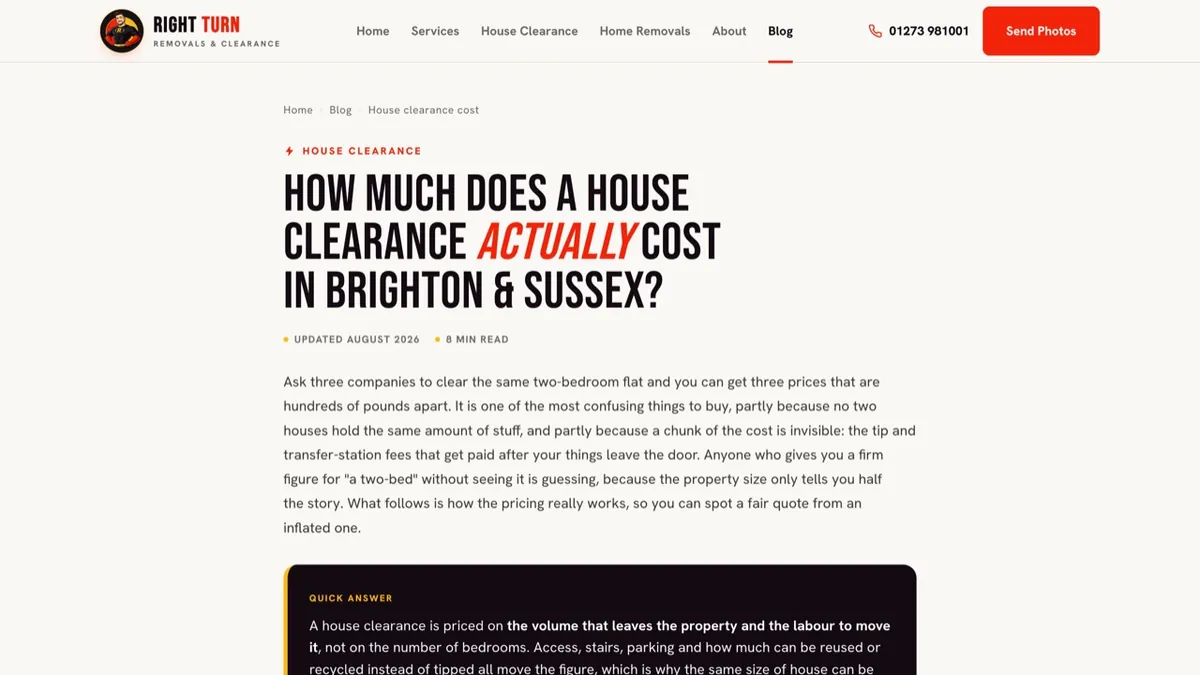
A Right Turn Removals article titled How much does a house clearance actually cost in Brighton and Sussex, with a Quick answer box.
A cost article on the Right Turn Removals site. The question a customer types is the headline, and the short answer sits in a box near the top.

What each fix costs, and how long it honestly takes

Four of the five causes cost nothing but your time. The fifth, a website Google can actually read, is £50 every four weeks with no build fee, or £350 every four weeks with the Maps work included.

The five causes, priced honestly

Grid scan to find out which cause you haveFree, one hour
Primary category, services and service areaFree, one hour
Review link and QR code, replies to allFree, ongoing, 1 to 3 months to tell
Name, address and number matched everywhereFree to £100, a weekend
Report a rule-breaking listingFree, 2 to 6 weeks, no promises
A site with real service and area pages£50 every four weeks
All of it done for you, Maps included£350 every four weeks

The website line is the Website plan, no build fee and nothing to pay on day one. The last line is SEO and Map Pack with the website included, or £300 every four weeks if you already have a site worth keeping.

The timescales are what people get sold badly. A category change is pure relevance and can show inside a fortnight. Reviews and profile activity are a one to three month story. A reported listing is out of your hands. So anyone promising the top three next week is either measuring from your own doorstep or guessing, and the organic picture is longer still, which I have set out in how long SEO takes to get trade jobs.

Ninety days is a fair target for a town or a suburb with a verified profile and a real service area. It is not a fair target for a dense city centre against thirty established listings. That is why the Google Maps work I sell starts with a scan of your patch and a straight answer about whether your search is winnable, before there is anything to sign. Sometimes that answer is no.

The bottom line: your rival is above you for a reason you can name by lunchtime, and usually a free one. Run the three searches from three places, read your primary category out loud, look at the dates on their reviews, then see whether your website says the same thing as your listing. Want the scan run for you? I will tell you which of the five it is and build a free mockup alongside it.

Frequently asked questions

Why is my competitor above me on Google Maps?

For one of five reasons, and Google names the first three itself: relevance, distance and prominence. Either their pin is nearer the person searching, or their primary category and services match the search better than yours, or they have a steadier flow of reviews, or their website and their listing agree with each other while yours do not, or their listing breaks Google's naming rules. Check them in that order. The first two are free and take minutes.

Does distance from the customer decide Google Maps rankings?

It is one of the three factors Google publishes, alongside relevance and prominence, and it is the one most trades misread. Searching from your own yard puts your pin closer to the phone than any customer ever will, so the position you see there is your best position, not your real one. A 7 by 7 grid scan checks 49 points across a radius so you can see where you drop out. Distance cannot be fixed, only worked around.

Can I report a competitor for keyword stuffing their Google Maps name?

Yes. Google's guidelines for representing your business require the name the business actually uses in the real world, on the van, the paperwork and the shopfront, so a listing called Best Electrician Worthing 24/7 is in breach. Report it through Suggest an edit on the listing, or through the data and content error route for a wider case. Document it first with screenshots, the date and a Companies House record. Google does not promise action or updates.

How many Google reviews do I need to get into the Maps top 3?

There is no threshold, and anyone who gives you one is guessing. Google says review count and review score feed into local ranking, without publishing a weighting. In practice across UK trades the useful target is a steady flow rather than a total: a handful of genuine reviews every month, each one answered, beats forty from three years ago. Buying them is a banned practice under Schedule 20 of the Digital Markets, Competition and Consumers Act 2024.

How long does it take to move up in Google Maps?

Category and service changes can move a position inside a fortnight because they are pure relevance. Reviews and profile posts build over one to three months. A reported listing takes two to six weeks and may never be actioned at all. Ninety days is a realistic target for a town or suburb with a verified profile, and it is not realistic for a dense city centre, which is why the honest answer starts with a scan of your own area.

Sources
  1. Google Business Profile Help, "Tips to improve your local ranking on Google", for relevance, distance and prominence as the three factors, and for review count and score feeding into local ranking. support.google.com
  2. Google Business Profile Help, "Guidelines for representing your business on Google", for the real-world business name rule and the restrictions on addresses, descriptions and duplicate profiles. support.google.com
  3. Google Maps Help, "Report data or content errors on Google Maps", for the reporting route beyond Suggest an edit. support.google.com
  4. Google Maps user generated content policy, for the ban on fake and incentivised reviews on the platform itself. support.google.com
  5. Digital Markets, Competition and Consumers Act 2024, Schedule 20, for the banned practices covering fake, incentivised and concealed reviews, in force from 6 April 2025. legislation.gov.uk
  6. Competition and Markets Authority, "Fake reviews" guidance (CMA208), published April 2025 alongside the new regime. gov.uk/cma
  7. Sitework's own hand audit of 100 real UK trade websites, for the finding that 58 named no town and no service. Published on this site as a sample audit, not a national survey.
  8. The 49-point 7 by 7 grid scan is the measurement method used on Sitework's Google Maps work. sitework.uk/google-maps
Done-for-you · £50 every four weeks

Find out which of the five it is Free Maps check first

Tell me your trade, your base and the one search you want the phone to ring on, and I will run the grid scan and tell you which of the five causes you have, and whether the top three is realistic in your area. If the answer is no, I will say so rather than sell you something. A website built and looked after for you is £50 every four weeks with no build fee and nothing to pay on day one, or £250 upfront and then £30 every four weeks if you would rather keep the ongoing bill low. SEO and Map Pack with the Google Maps work is £300 every four weeks on a site you already have, or £350 with a site I build and host, with a £150 deposit taken off the first payment. Three months minimum and then rolling. Live in about a week.