"I am Gas Safe registered" is not what sets a plumber apart, because the law says you cannot do gas work without it.
I checked that against the market on 2 October 2026. I searched Google Maps for "plumber horsham", then read the homepage source of the seven plumbing firms in the organic results, looking for Gas Safe, WaterSafe and Oftec. Six of the seven mention Gas Safe. One prints its register number. One names WaterSafe. None mentions Oftec. When almost every firm in a UK town makes the same claim, the claim stops winning anybody a job,.
So the question for a plumber deciding whether to pay for SEO is narrower than the agencies make it. Which of your jobs does search actually win, and which does it not?
What the Horsham plumbing pack shows
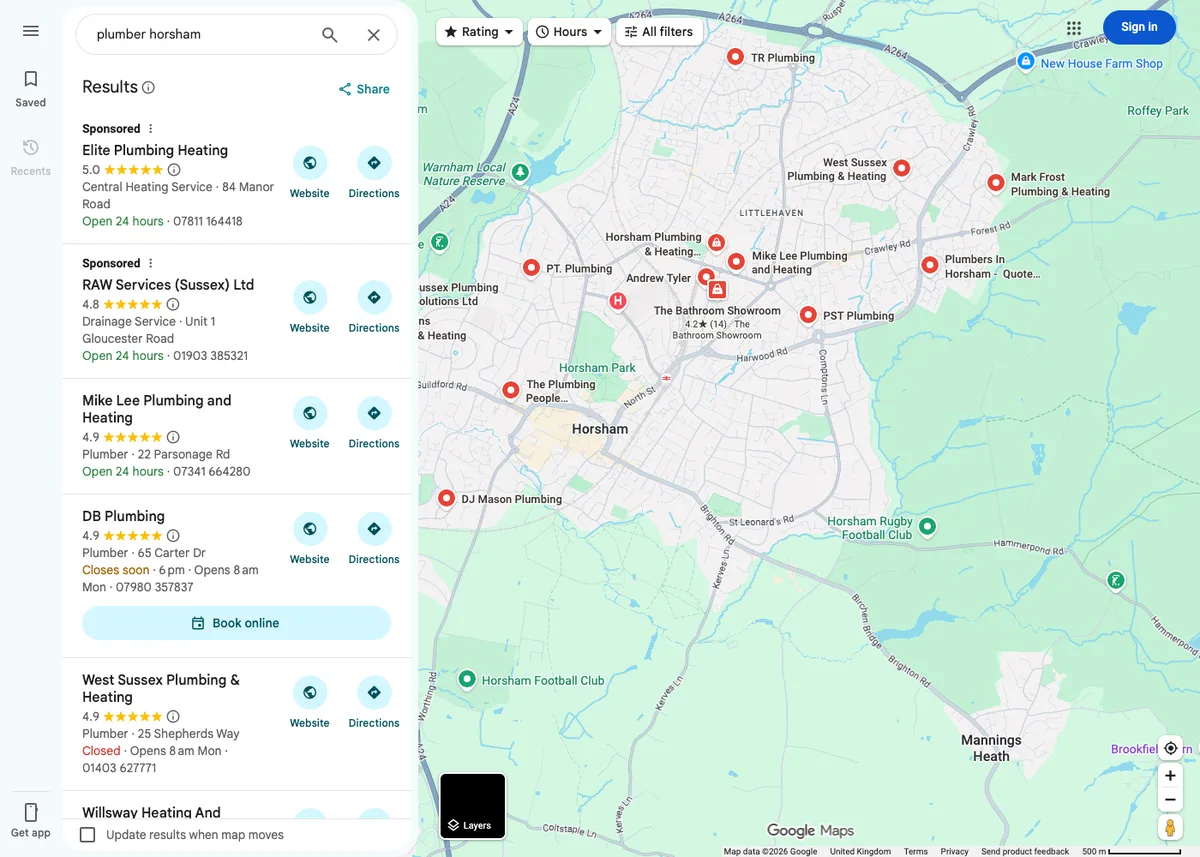
On the afternoon of Friday 2 October 2026 the Google Maps pack for "plumber horsham" showed two sponsored listings, then plumbers rated 4.9 or higher, and the labels on their listings differed by the hour: one said "Open 24 hours", one "Closes soon" and one "Closed".
The capture below shows it: signed out, centred on Horsham, taken shortly before six in the evening. The time matters for plumbers more than most trades, because an emergency search does not wait for office hours. A listing that reads "Closed" at that moment is competing against one that reads "Open 24 hours", whatever the firm actually does behind it, so set your hours on the profile to match what you really offer.
The method for the finding in the introduction was plain: raw homepage source of the seven organic firms, stripped of scripts and styles, searched for "Gas Safe", "WaterSafe" and "Oftec". It is seven firms in one UK town on one day, and a logo shown as an image would not appear in the text, so read it as a pattern rather than a census. The pattern is that Gas Safe is mentioned almost everywhere and proof beyond it is rare.
The law makes Gas Safe a baseline, not an edge
The HSE says that under the Gas Safety (Installation and Use) Regulations 1998 a gas engineering business must be on the Gas Safe Register to legally carry out gas work within the Regulations, so registration is the entry ticket.
The HSE also notes that registered engineers carry an identity card and that consumers are encouraged to ask for it before gas work in their home, in its guidance on the Gas Safe Register. That gives you two things worth putting on your site: your register number, so a homeowner can look you up, and a line telling them to ask for your card. Printing the number is a small thing, and in the Horsham sample it was done by one firm in seven.
Gas Safe is not the only scheme. WaterSafe describes itself as a free national directory of qualified plumbers and water installers, and says approved contractors issue certificates of compliance for work under the Water Fittings Regulations. It does not present itself as a legal requirement, so if you hold it, say so as a mark of competence rather than as a rule of law. For oil boilers the equivalent is Oftec, which none of the seven mentioned. I did not check its register this session, so I make no claim about it here beyond that.
Which of your jobs does SEO win? A decision map
Search wins the jobs where the homeowner is choosing from a list in the moment, and does little for the jobs that arrive by word of mouth, so the map below is by job, not by trade.
The map is my judgement from how each job is bought, not a measured conversion rate, and your own numbers should overrule it. If you want to see how your trade looks on the map before spending anything, whether plumbers need a website at all covers where the work comes from first.
What to put on the page so Gas Safe works for you
Registration only helps a homeowner who can verify it, so the page should carry your number, tell them to ask for your card and say plainly which work it covers.
Start with the number, in text rather than only in a logo image, so it is visible to a person and to a search engine. Next to it put one sentence telling the homeowner to ask for your identity card before gas work starts, which is the step the HSE encourages. Then separate the work: say which jobs are gas work covered by registration and which are general plumbing, so nobody assumes the card covers a tap washer.
Add the rest of the proof a homeowner cannot get from the pack. Your hours, stated honestly. The towns you cover, written as sentences. A short note on any scheme you hold beyond the legal one, such as WaterSafe, with a link to the directory entry. And a page for each of the jobs in the map above that ties the service to a place, because "boiler installation in Horsham" can only rank on a page that is about it. A plumber who does these things has a printed register number, which in my sample only one firm in seven showed, and none of it needs a technical trick.
What a month of plumber SEO should and should not include
A good month leaves you with a better profile, more reviews, new pages for named jobs and towns, and a report with calls and map position, none of which depends on a promise about ranking.
Google ranks local results on relevance, distance and prominence, and its own help page says there is no way to request or pay for a better local ranking, in its local ranking guidance. So the month should move those three things: services and categories on your profile checked against how you describe the job, a review request after each completed job, and pages that tie a service to a place. It should not include bought links, bulk directory submissions or posts that name no town, and it should not promise a position.
Ask for the report to carry calls, direction requests and your position on named searches measured across a map grid, because one screenshot from one spot says very little. I go through what a report should contain in whether it is worth paying someone to manage your Google profile.
What it costs, with the other price points beside it
Published UK agency prices for local SEO that I could read on 2 October 2026 ran from £300 plus VAT a month to £850 a month, against £300 every four weeks from me with no VAT added.
| Supplier | Published price | Seen |
|---|---|---|
| Outrank, local starter plan | £300 plus VAT a month | 2 October 2026 |
| SEO Moves, local ranking | £350 to £850 a month | 2 October 2026 |
| Sitework, SEO and Map Pack | £300 every four weeks, no VAT | Current |
Prices are as published on each supplier's own page, which I read that day, and will have moved since. They are not like for like: plans differ in what they include, so compare the deliverables rather than the number. Mine is £300 every four weeks on a website you already have, or £350 with a website I build and host, a £150 deposit off the first payment, twelve weeks minimum and then rolling. I am not VAT registered. It includes a 7 by 7 grid scan on up to three agreed searches, with billing paused if the average position is not in the top three by day 90, as set out on the Google Maps guarantee page.
What a year of it comes to
| SEO and Map Pack, £300 every four weeks | £3,900 |
| With a website built and hosted, £350 every four weeks | £4,550 |
| Deposit, taken off the first payment | £150 |
Thirteen payments a year rather than twelve. This is arithmetic on my own published prices. What one boiler installation or a year of landlord certificates is worth to you is your figure.
Three questions before you pay anyone
Bottom line: pay for plumber SEO when your best-paid jobs are boilers, landlord certificates and local emergencies, and make the fee earn its place by putting your register number, your hours and your areas where a worried homeowner can see them. If you are weighing the lead sites against SEO first, Checkatrade, MyBuilder and Rated People compared sets out what each one costs you.