How do bathroom fitters get jobs without Checkatrade? Start with the term nobody has claimed
A bathroom fitter rang me in August. He had cancelled his membership in the spring, the diary was full until October on repeat work, and he could not answer one question: what happens in November.
That is the real shape of this problem. Almost nobody leaves a lead platform and immediately runs out of work, because the leaving is usually paid for by a backlog. The trouble arrives one quarter later, when the backlog clears and there is nothing behind it. So before I answered him I went and looked at what his market actually contains. I searched his trade, in the three market towns he covers, and counted what came back. Fifteen businesses, across all three towns, and exactly one of them had bathroom fitting in its name. In most UK trades the advice is to fight for a crowded search term. In this one, on this evidence, the term is not crowded. It is vacant, and the people occupying it are not fitters.
From three places, in this order: the work you have already done, the showrooms and merchants you already buy from, and a site that owns your trade plus your town. Across three English market towns, six of the fifteen businesses returned for bathroom fitter were showrooms or merchants and four were plumbing firms. The search term is not contested in the UK regional market. It is unoccupied.
I searched bathroom fitter in three market towns. One result was a bathroom fitter
Fifteen distinct businesses came back across three towns. Six were showrooms, tile retailers or merchants, four were plumbing and heating firms, and one carried bathroom fitting in its trading name.
These come out of a listings sweep I keep for cold-calling, covering eighteen trades across Ludlow, Craven Arms and Church Stretton in Shropshire. I took every result returned for the bathroom fitter query in all three towns, deduplicated by business name and telephone number, and classified each one by what its trading name says it does. That last step is a judgement call and I would rather say so than dress it up: a firm called Stretton Renovations may well fit more bathrooms than anybody else on the list. What the name tells you is what a customer reads before they click, which is the thing this post is about.
Fifteen distinct businesses returned across Ludlow, Craven Arms and Church Stretton, deduplicated by name and phone number, September 2026. Classified by trading name. No business is named here.
The detail that decided how I answered him
Of the two that name bathrooms, one reads as a showroom and one is a fitter. That fitter is on a free site builder subdomain and shows two reviews. Meanwhile the two highest review counts on the whole list, 38 and 37, belong to a plumbers' merchant and a plumbing and heating company. Across the fifteen, the median review count is 7. Run the same sweep for tiler in the same three towns and the median is 25; for plumber it is 14. So the businesses contesting bathroom fitter are, on Google's own visible signal, the weakest of the three groups.
Twelve of the fifteen have their own domain. One has no web address at all, one is represented by a directory listing, and one is on that free subdomain. Three towns in one county is not a national sample and I will not pretend otherwise. But it is real, it reproduces, and anyone can run the same check on their own patch in ten minutes. Do that before you accept anybody's account of how competitive your market is, mine included.
The showroom is your competitor in the results and your best referrer off them
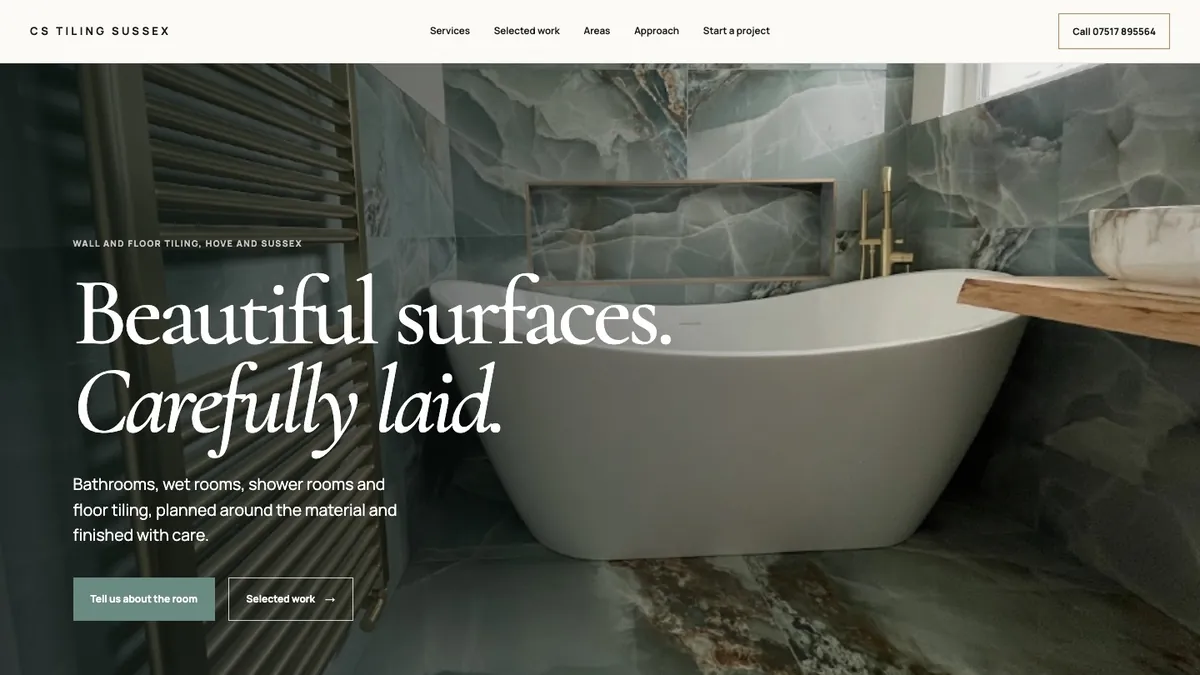
Six of the fifteen results sell bathrooms rather than fit them, and most of them need a fitter they trust. That is the same list twice: the people outranking you are the people who can hand you work.
This is the part of the answer that has nothing to do with websites, so take it first. A bathroom showroom sells a suite and then has to find somebody to install it. A plumbers' merchant watches fitters walk in every morning. Both are asked, constantly, whether they know anyone. In every fit-out trade I have built for, that referral route produces better work than any platform: the customer has already chosen and paid for the suite, so the price conversation is about labour only, and they arrive pre-warmed by somebody they trust.
What the platform is actually charging, and what it takes with it
Checkatrade's published starting points in September 2026 were £30 a month for a listing and from £59 a month for the lead-carrying plan, on twelve month fixed terms. The bills tradespeople report are several times that.
I want to be fair to the platform here, because the case against it does not need exaggerating. The published figures are modest. What is not modest is the spread between them and what people actually pay: reported monthly bills in trade forums through 2024 to 2026 run from around £80 to £500, driven by lead volume and area. On a bathroom refit the per-job lead charge is at the top of the range, because the platform prices a lead against the job value rather than against your margin.
Which route to build first, given where you actually are
There is one right first move and it depends entirely on whether the repeat and referral work is already there. Build the route you are weakest in, not the one you enjoy.
The two questions a bathroom gallery cannot answer
How long will I have no bathroom, and who is certified for the water and the electrics. Answer those two on the page and you remove the reasons a warm enquiry goes cold.
A bathroom is different from a kitchen in one way that matters to the buyer more than any photograph: the house has usually got one. A full installation commonly runs five to ten working days, and a customer with one bathroom and two children is doing arithmetic about that the whole time they are looking at your tiling. Say the number. A page that reads "most full bathrooms are five to seven working days, and the toilet goes back in on day two wherever the layout allows" wins against a better gallery that says nothing.
The certification point, which is genuinely worth the space
Under the Building Regulations for England and Wales, a bathroom is a special location, and electrical additions or alterations inside it are notifiable work rather than the ordinary exemption most rooms get. On the water side, a plumber on the WaterSafe register can self-certify work that would otherwise need advance notification to the water company, and the completion certificate is a defence for the homeowner if the supplier ever challenges the installation. Most bathroom fitters either hold one of these or sub it out to somebody who does. Almost none of them say which on their website. Naming it is free, it is checkable, and it is the single most persuasive sentence available to this trade.
What a year of each route costs, side by side
Against labour of £1,500 to £4,000 on a single full bathroom, every route on this table is cheap. The difference between them is not the price, it is who owns the result at the end of the year.
| Route | Roughly, a year | Who owns it | Honest verdict |
|---|---|---|---|
| Showroom and merchant referrals | Nothing but time | You, but it rests on relationships | Start here. Best quality of work on the list |
| Google Business Profile | Free | Google, and it can be suspended | Do it this week. It is not optional and it is not enough |
| Lead platform, published starting tiers | £360 to £708 | The platform, including the reviews | Fine as a top-up, poor as a foundation |
| Lead platform, reported real bills | £960 to £6,000 | The platform | The number people actually pay. Check yours |
| Maintained website of your own | £650 | You, and the domain transfers after twelve months | The only line that still exists if you stop paying |
Website costs are an allowable business expense for a self-employed trader in the UK, so that £650 comes off your profit before HMRC takes a view of it. I ran the same arithmetic in more depth for the trade next door, in what a kitchen fitter should pay for a website, where the job values are higher and the conclusion is the same.
What I told him to do, in order
Photographs first, reviews second, the free profile third, the site fourth. Three of those four cost nothing, and the fourth is worth less without them.
Six bathrooms photographed properly, in daylight, before the customer moves their things back in. A review asked for at the door of every one of them, not by text a week later. The Google Business Profile claimed and fed. Then a site that says bathroom fitter and the name of his towns, states fit-only clearly, gives a working-days number and says who certifies the water and the electrics. He will not out-advertise a national platform in his part of Shropshire and he does not need to. In a search where one result in fifteen names the trade, being the obvious answer is a much smaller job than it sounds.
If you want the site part handled rather than added to the evening list, that is what I do: £50 every four weeks with no build fee and nothing payable on day one, and you see a free mockup of your own bathrooms on the screen before any of it is payable. If you would rather build it yourself on a site builder for £10 to £25 a month, do that instead. Either way, do the photographs and the reviews this month. They are the part nobody can do for you and the part everything else stands on.